

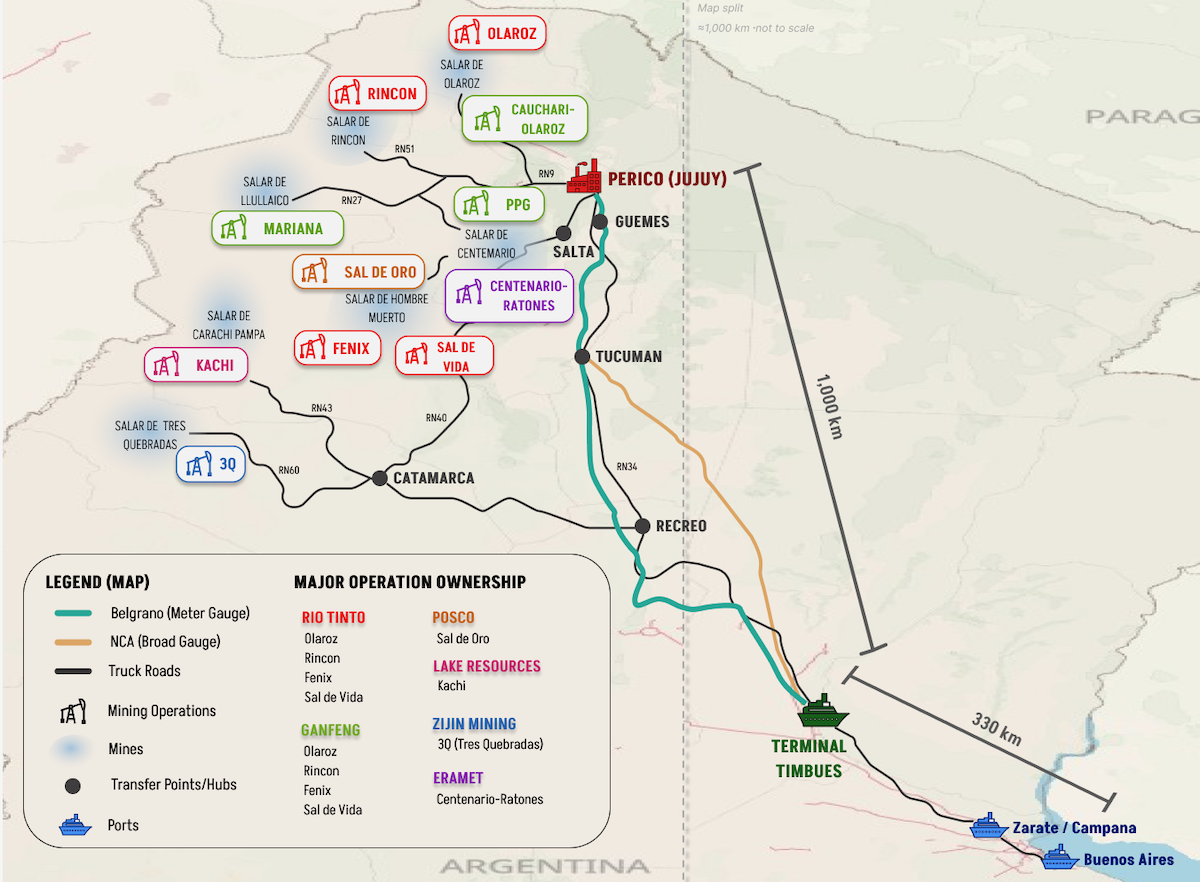
On September 23, the United States and Argentina launched the Andes-Atlantic Corridor, the first Partnership for Global Infrastructure and Investment (PGII) corridor in the Western Hemisphere. The initiative aims to modernize the infrastructure linking Argentina’s mineral-rich northwest and the Vaca Muerta energy basin to Atlantic ports and Western markets. New research from Xtellus examines what that shift could mean for one of the region’s fastest-growing supply chains: lithium.
Xtellus is an anchor investor in Terminal Timbúes, Argentina’s first RIGI-qualified port infrastructure investment. The deepwater terminal on the Paraná River sits at the nexus of the Hidrovía waterway and the Belgrano rail network, two of the transport arteries the Andes-Atlantic Corridor is designed to strengthen. The report, Securing the Soda Ash–Lithium Supply Chain into Argentina, compares the established Pacific route into Argentina’s lithium provinces with an emerging Atlantic alternative through Timbúes.
A Two-Way Freight Challenge
Argentina holds roughly 20% of the world’s lithium resources, and its Puna region, spanning Jujuy, Salta and Catamarca, is moving from development into full-scale production. Turning lithium brine into battery-grade lithium carbonate requires soda ash: about two tons for every ton of lithium carbonate produced.
Based on conversations with industry participants, Xtellus estimates that the region’s lithium projects could require around 1.5 million tons of soda ash a year by 2030. That creates a freight challenge in both directions. Soda ash must travel inland to the mines, and lithium carbonate must travel out.
The Incumbent Pacific Route
Today, approximately 96% of the region’s soda ash arrives through Antofagasta in Chile, mostly from Asian suppliers, before crossing the Andes by road. The route is mature and works at current volumes. It also has structural limits. Mountain roads restrict trucks to 26 tons, the passes close seasonally and every shipment clears an international border. Those constraints become more significant as lithium output grows.
The Case for an Atlantic Route
Natural soda ash, mined principally in Wyoming and Turkey, costs roughly half as much to produce as the synthetic material that makes up most Chinese supply, and emits roughly half the CO₂ per ton. Ocean voyages from the US Gulf and Turkey to Argentina are shorter than the Pacific route used by Asian suppliers. Once landed, rail and truck combinations on the Argentine side can carry around 52 tons per movement, about double the payload of an Andean truck.
The report brings these factors together in a delivered-cost comparison. For duty-paying buyers, it estimates that US soda ash shipped through Timbúes lands at around $341 per ton today, compared with around $364 for Chinese material through Antofagasta, including import duty. Once the Belgrano rail network is upgraded, the US-origin figure could fall to around $306 per ton, the lowest delivered cost in every buyer segment the report examines.
Trade policy supports the same conclusion. Under the US-Argentina Agreement on Reciprocal Trade and Investment, US soda ash is positioned to enter duty-free once Argentina’s Congress ratifies the agreement.
The estimates are directional, drawing on third-party data and industry conversations, and the rail upgrade carries execution risk. Bids for the Belgrano Cargas concession are due on November 11, 2026.
Terminal Timbúes as the Nexus
Timbúes is the northernmost Panamax-capable terminal on the Paraná, about 467 kilometers upriver from Buenos Aires. It serves as a gateway where the Hidrovía, the river system that carries ocean-going vessels between the Atlantic and South America’s interior, meets the Belgrano rail network running directly to Salta. Its first phase, a fertilizer and dry bulk terminal with 480,000 tons of storage, is scheduled to open in the fourth quarter of 2027. Agro-bulk and liquids terminals will follow on the 186-hectare site.
The same infrastructure works in both directions. Rail capacity that carries reagents inland can carry lithium carbonate out, alongside grain from Argentina’s northern provinces. An estimated 10 to 11 million tons of grain move from the region to the Gran Rosario ports each year, nearly 80% of it by truck. That return cargo strengthens the economics of the entire route.
“Our terminal is a gateway to the region from the Atlantic for suppliers, and a key strategic asset for securing US national security interests in critical minerals,” says Greg Gigliotti, Chief Investment Officer and Founding Partner of Xtellus Advisors, LLC.
Aligning With the Corridor
The Andes-Atlantic Corridor brings together rail, waterways, ports, power and digital infrastructure, including the Hidrovía and Belgrano networks that converge at Timbúes. It is supported by a US Export-Import Bank framework that could mobilize up to $7 billion through 2027. The Xtellus research suggests that an integrated Atlantic route through Timbúes can give Argentina’s lithium industry a secure, lower-cost, US-aligned supply chain alongside the Pacific route.
The report also argues that timing matters. Natural producers currently hold a cost and carbon advantage, and Asian producers are investing in natural capacity of their own. Establishing the Atlantic route ahead of the production ramp expected from around 2028 positions the corridor to grow with demand.
Read the full report here: Securing the Soda Ash–Lithium Supply Chain into Argentina
Read the US State Department fact sheet on the Andes-Atlantic Corridor: https://www.state.gov/releases/office-of-the-spokesman/2026/09/united-states-and-argentina-launch-andes-atlantic-corridor-fact-sheet
Disclaimer: This report is provided for informational purposes only and does not constitute an offer to sell or a solicitation of an offer to buy any security, nor investment, legal, tax or accounting advice. Cost estimates, projections and other forward-looking statements are directional, rely on third-party data and industry conversations not independently verified, and are subject to change without notice; actual results may differ materially. Xtellus undertakes no obligation to update this material.