

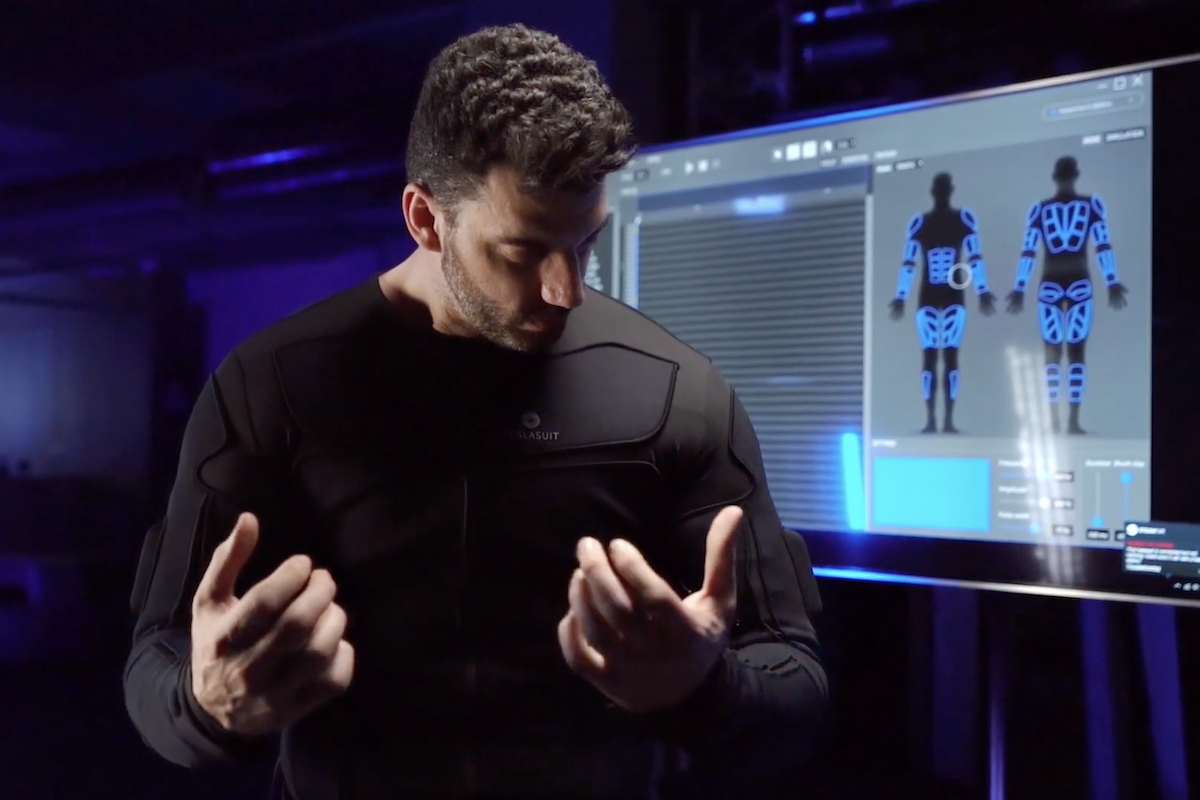
It sounds like the work of science fiction. A full-body haptic suit that can simulate everything from G-forces on fighter pilots to physical therapy exercises for remote patients. But in reality, those are just two examples of Teslasuit’s real-world applications.
Founded in 2016, Teslasuit is an immersive AR/VR technology company that creates what are essentially wearable computer interfaces, or as the industry calls it, human computer interactions (HCIs). The suit tracks the wearer’s biometric data, while providing tactile feedback through electrical muscular stimulation. This allows the wearer to touch and feel digital recreations of real-world environments.
One-of-a-Kind Technology
Haptics refers to technology that can simulate a sense of touch. Using force, vibration, and motion, haptics creates physical sensations in digital interactions. It essentially lets users “feel” virtual objects.
Some common everyday applications of haptics include confirming actions through vibrations (like on your phone) or force feedback (like in a steering wheel). Teslasuit is applying this technology at unprecedented levels of sophistication, from providing crucial feedback in medical simulations to safely preparing oil rig workers for emergencies.
Teslasuit is the only smart wearable in the market to integrate haptics, biometrics, and motion capture with custom haptic software. Together, these innovations allow teams to imitate the physical effects of real-world scenarios for wearers, and gather biometric data on how the human body responds. This unique combination makes possible massive developments in enterprise training, research, and healthcare.
Breakthroughs in High-Risk Training, Medical Research, and More
To return to an earlier example, fighter pilots need to be able to sustain high-speed maneuvers despite the immense physical stress from G-force (g’s), or the measure of acceleration relative to the earth’s gravity. The average pilot will need to sustain between 9G to 10Gs. Training for this force has traditionally been incredibly difficult, but with Teslasuit, they can mimic what this actually feels like without exposing the pilots to real risk.
This capability is also critical in high-risk, high-touch scenarios like healthcare and environmental safety. As AI moves into the physical dimension with autonomous robotics, Teslasuit is poised to help with robot training and remote operation. The suit collects important human-centric data for training, and is the only technology that allows human operators to manipulate and “feel” what a robot is sensing in the environment.
Through medical partnerships with prominent facilities like Amsterdam’s Rehabilitation Research Center Reade and New York’s Hospital for Special Surgery (HSS), Teslasuit is already exploring rehabilitation applications. Reade is using Teslasuit in early trials with mariners who have limited mobility after an incomplete spinal cord injury (ICSI). The suit provides low-energy electrical pulses that artificially generate body movements to help speed recovery.
With HSS, the long-term goal is for patients to be able to perform prescribed exercises at home while transmitting detailed movement and muscle response data back to their medical teams. Partnering with these world-class academic centers, Teslasuit supports the research and development of new functionalities that can change the way doctors treat patients.
A Unique Investment Profile
Recently, Teslasuit has restructured to fully focus on premium market segments, such as government and enterprise clients. “We believe this approach will allow the company to grow meaningfully in sectors that prioritize safety, precision, and memorable outcomes,” says Paul Swigart, CEO and Founding Partner of Xtellus Ventures, a long-standing investor and advisor to Teslasuit.
The company already has established partnerships in healthcare and defense, plus a pipeline of enterprise clients, and it’s a unique opportunity for the right investor to participate in a seed round at a valuation that provides substantial long-term upside.
Looking ahead, Teslasuit’s 2026 flagship model, the XR5, represents the next evolution of their technology. It introduces significant technical upgrades, including encrypted firmware, a proprietary algorithm for advanced gait analysis, and a plug-and-play virtual lab for developing and testing experiences.
As Teslasuit scales production, we’re likely seeing the first chapter of a much larger story about how humans will work, train, and heal in an increasingly digital world.
To learn more about Teslasuit applications and technology, visit https://teslasuit.io/.